
What "real money" means for pokies
Real money means real dollars staked and real dollars either lost or won on each spin. For payid pokies that means an Australian bank account funds a balance at an offshore-licensed operator via PayID, and that balance is then wagered on reel-driven RNG games. Every symbol combination that lands corresponds to a payout in the paytable priced against the actual stake. There is no play-money layer; the wallet is your wallet and the numbers on the screen are the actual dollars flowing.
This is not the same as playing free demo mode. The maths engine underneath is identical — same RNG, same paytable, same volatility profile. What differs is the psychological register. Studies of pokie behaviour consistently show that identical players play measurably differently in real-money and demo sessions, chasing losses more aggressively, holding losing positions longer and taking wins less patiently once real money is on the line. The maths does not know or care; the player does.
For payid pokies real money play, that psychological register is the primary risk factor. The maths is fixed by the studio. The bankroll is fixed by you. The behaviour in between is where sessions turn well or badly. This guide focuses on the practical structure around the play — the cashier flow, the bankroll rules, the withdrawal habits — because that is where reviewer-usable information actually lives.
Deposit flow via PayID step by step
A PayID deposit to an offshore operator that accepts PayID from Australian banks follows a fixed pattern. The details vary by operator, but the flow is broadly identical across the payid pokies portfolios that carry the payment method.
- Log in to the operator, open the cashier and select PayID as the deposit method.
- The cashier displays a target PayID — usually an email address or ABN — and a reference code.
- Open your bank app, initiate a PayID payment to that identifier, add the reference code and enter the deposit amount.
- Confirm the payee name and amount in your bank app; approve the payment with your usual authentication.
- The NPP rail settles the transfer in seconds; the operator cashier reconciles the payment and credits your balance.
- Return to the pokie lobby, pick a title and confirm the balance is correct before spinning.
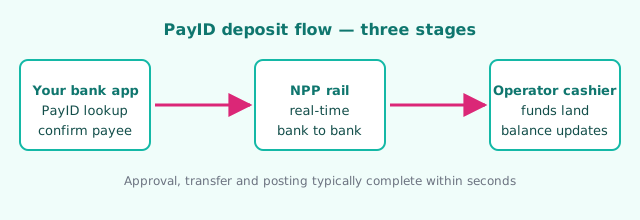
Two frictions are worth flagging. First, your bank may apply anti-fraud pauses on outbound PayID payments to unfamiliar payees. This is a legitimate safety measure — approve or override only if you have already verified the operator independently. Second, the reference code matters. Cashiers reconcile incoming PayID transfers by that code; a missing or wrong reference can leave the deposit in an unreconciled pool for hours until manual review. Enter it carefully.
Bankroll planning before the first spin
Bankroll planning is where payid pokies real money play separates the entertained from the frustrated. The bankroll is the total dollar amount you have chosen to commit to a session or a period. It is a sunk cost the moment you decide it, not an investment you expect to recover. Every session-planning rule flows from that framing.
A basic rule of thumb from the review desk is the 100-spin buffer. Take the stake per spin you want to play. Multiply by 100. If your bankroll for the session covers at least that number, the session has a fighting chance of reaching the maths of the title over a reasonable number of spins. Below that, the bankroll is too small for the volatility, and the session will almost certainly end before the title's mechanic has really unfolded. High-volatility titles need a deeper buffer — often 300-500 spins — because their dry patches are longer.
| Stake per spin | Buffer for medium volatility | Buffer for high volatility | Buffer for extreme volatility |
|---|---|---|---|
| $0.20 | $20 | $60 | $100 |
| $0.50 | $50 | $150 | $250 |
| $1.00 | $100 | $300 | $500 |
| $2.00 | $200 | $600 | $1000 |
The table above is a floor, not a target. Nothing about it guarantees a positive session — payid pokies remain house-edge games. What the buffer buys is the chance to actually experience the design of the title before the session ends. Sizing down the stake to fit the bankroll is the single most useful adjustment a real-money player can make; sizing up under pressure of losses is the classic mistake to avoid.
RTP over sessions versus single sessions
Certified RTP figures apply over the theoretical long run — millions of spins by many players. A single session of a few hundred spins samples such a small slice of that distribution that session RTP is dominated by variance rather than expectation. This is the single most misunderstood point in payid pokies real money play.
On a 96% RTP title, the expected return over infinity is $96 per $100 wagered. Over a 300-spin session at a $1 stake, the observed return can plausibly be anywhere from $0 to well over $500. The variance is not a bug — it is the definition of the volatility rating. A high-volatility title has wider variance than a low-volatility one. The RTP figure is the balance point of the distribution, not the ceiling or the floor. Session outcomes cluster around the RTP only when the sample of spins is many thousands large; a single evening does not qualify.
The reviewer's honest framing is that RTP is a design specification, useful for comparing titles category by category, but not useful for predicting a session. A player who commits a bankroll expecting to "get back 96%" over an evening is misreading the number. Better framing: the RTP is what the studio priced the maths at; the session is a random sample that could land anywhere in a wide distribution around that price. For a broader look at reviewer-lens interpretation of certified figures, see the payid pokies homepage.
Managing autoplay in real-money sessions
Autoplay is a feature that lets a real-money player queue a fixed batch of spins to run automatically. It saves clicks and creates a smoother session tempo. It also removes friction — every manual spin is a small decision point where the player has an opportunity to stop; autoplay bypasses those points until the queue ends or a stop condition triggers. That trade-off is worth making consciously.
Studios operating under stricter jurisdictions have built mandatory autoplay guardrails into their titles. Common toggles include stopping on a single win above a threshold, stopping on a balance decrease of a set amount, stopping when free-spin features trigger and stopping when the balance runs out. On payid pokies titles served under lighter regulatory regimes, the toggles are optional or occasionally absent. Where they exist, use them.
- Set the autoplay count to fit your session, not the maximum available (some titles allow up to 1000 spins queued).
- Enable "stop on any win over X" — X can be 50 times the stake as a starting point.
- Enable "stop on balance decrease of X" — X can be 20% of your session bankroll.
- Always enable "stop on bonus feature" so the feature is played consciously, not skipped past in a queue.
- Do not stack autoplay across multiple pokie tabs in the same browser session.
These are floors, not ceilings. Some real-money players prefer manual spinning throughout the session precisely because the friction acts as a natural circuit-breaker. If manual spinning suits your habits, there is no design argument for switching to autoplay. Convenience is not always an improvement.
Withdrawal thresholds and cashout habits
Withdrawal via PayID from real-money wins works in the reverse direction of the deposit. From the operator cashier, you select PayID as the withdrawal method, enter your PayID (email address, mobile number or ABN) and confirm the amount. The operator processes the withdrawal, usually within hours for verified accounts, and the NPP rail settles the payment to your bank account. First-time withdrawals may take longer because of KYC verification steps — passport or driving-licence upload, proof of address, sometimes proof of the deposit source.
Withdrawal habits are what separate one-off winning sessions from a sustainable pattern. The most common regret in payid pokies real money play is grinding a winning session back down to the original deposit because no cashout threshold was set. A common threshold is 2x the deposit — the moment the balance passes twice the original deposit, withdraw the original stake back to your bank and continue playing only with the profit. A stricter version withdraws the entire balance at 3x deposit and starts fresh on a smaller stake.
Withdrawal thresholds do not lock in a positive session outcome — a session can still go badly after the threshold is passed and reversed. What they do is stop the ratchet effect where a winning position is slowly returned to the operator by unwillingness to close it. Set the threshold before starting the session and hold to it. Read the best payid pokies guide for how category selection interacts with withdrawal timing on high-volatility titles where wins arrive rarely but in bursts.
Session-end habits worth building
Sessions end. The question is whether they end at a moment you chose or a moment you did not. Building the habit of a defined session end is one of the more useful behavioural adjustments in payid pokies real money play. A defined end is a specific balance threshold or a specific time on the clock — 90 minutes, or the balance hitting either the withdrawal threshold or the loss limit. Whichever comes first stops the session.
End-of-session actions look mundane but matter. Withdraw whatever is above your original deposit. Close the browser tab or app. Do not open a second title at the same operator "just to check". The end of a session is a real event; treating it as one prevents the mission-creep pattern of playing on because the previous session went well or because it went badly. Both patterns end the same way statistically.
Some operators offer session-length pop-ups — reality-check prompts every 30 or 60 minutes reminding you how long you have been playing and what the net win or loss is. Where those exist, keep them enabled. They are one of the more effective behavioural nudges on offer and cost nothing to use. If a payid pokies operator does not offer them at all, that absence is a signal worth weighing.
Handling wins and losses realistically
Winning sessions and losing sessions both need handling because both create predictable behaviour patterns worth resisting. A big win in a real-money payid pokies session creates a mood boost that can lead to increased stake sizes or extended session lengths — both of which push the session back towards its expected value, which is negative. A big loss creates the opposite pattern: chasing behaviour, larger stakes, longer sessions in pursuit of recovery.
The reviewer's plain advice is the same for both. When a session ends at a win, withdraw the profit and close the session at the planned time. Do not "let it ride" or move to a higher-stake table because the maths still runs against you and a big early win is precisely when the ratchet effect is most seductive. When a session ends at a loss, close the session, log out and do not open another until the pre-agreed cool-off period has passed. Chasing does not work statistically — every additional spin at the same house edge continues to work against you.
Realistic framing helps. Over any meaningful number of sessions the average outcome is a net loss because the house edge is baked into the maths. A profitable evening is a lucky roll of variance, not evidence that the maths has shifted in your favour. Enjoying the profitable evenings and closing the losing ones on time is the achievable version of a healthy relationship with payid pokies real money play.
What real-money play requires practically
Practically, payid pokies real money play requires a small set of things a player must have in place before opening the cashier. First, a verified Australian bank account with PayID registered. Second, a chosen operator that accepts PayID and hosts the studios you want to play. Third, KYC documentation ready — passport or driving licence, proof of address — because the first withdrawal will require it. Fourth, a session bankroll separated from household expenses. Fifth, session limits set on the operator side and, ideally, transaction limits set on the bank side.
Two often-overlooked prerequisites. Australian gambling winnings are generally treated as non-taxable for individual players because the ATO views recreational gambling as a hobby rather than income. That treatment can change for players whose activity looks systematic or business-like; if that is you, get tax advice. And second, individual PayID limits vary by bank. Most Australian banks default outbound PayID limits around $10,000 per day but many customers have lower per-transaction caps by default. Check your bank's app before assuming a deposit will go through.
Combine those prerequisites, set the bankroll, choose the title category and open the cashier. The session that follows will be governed by the maths engine of the title, your bankroll discipline and your session-end habits. Nothing else meaningfully changes the picture. The remainder is entertainment.
Frequently Asked Questions
How fast do PayID pokies deposits actually settle?
Most PayID transfers to operator cashiers settle within seconds because they use the NPP rail. The pokie balance updates as soon as the cashier reconciles the incoming payment, usually before the next spin can be started. Slower settlements occur only when banks apply anti-fraud holds or when a reference code has been entered incorrectly.
Is a real-money session materially different from demo?
Yes and no. The RNG and paytable are identical. What changes is the psychological weight of loss and the practical reality of a shrinking bankroll. Behaviour in real-money sessions is measurably different from demo sessions, even on the same title. That is worth planning for.
Do RTP figures apply to a single session?
Only in expectation, not in reality. Session RTP can sit far from the theoretical figure. Only across many thousands of spins does the observed return converge on the certified number. Plan bankrolls for session-level variance, not for theoretical averages — this is where most real-money misunderstanding lives.
Should I use autoplay for real-money sessions?
Autoplay is fine when its guardrails are set — stop on any large win, stop on balance decrease, stop on bonus feature. Autoplay without those toggles enabled removes an important friction point that manual spinning provides. If in doubt, spin manually and treat the click as a decision.
What is a sensible withdrawal threshold?
A common approach is to withdraw whenever your balance exceeds your original deposit by a set multiplier — for example, twice the deposit. That crystallises the win and prevents the ratchet effect of grinding a winning session back down to the deposit. Set it before starting; do not decide mid-session.
Do wins from real-money pokies get taxed in Australia?
Individual Australian gambling winnings are generally treated as non-taxable by the Australian Taxation Office because gambling is not carried on as a business by ordinary players. Professional gamblers are treated differently. Always check current guidance with a tax professional if your situation is unusual.

Olivia Parker
Pokies Reviewer · SH Info
Olivia reviews Australian pokies since 2017 with a focus on RTP claims, volatility experience and provider ecosystems. She distinguishes documented behaviour from marketing narrative.
Responsible Play
Real-money play at any offshore payid pokies operator is entertainment with a mathematical house edge. Bankroll planning, session-end habits and withdrawal thresholds are the tools that keep the session in the entertainment register rather than sliding into harm. Read the Gambling in Australia Wikipedia entry for the fuller context on how the domestic and offshore markets fit together.
Confidential 24/7 support is available in Australia through Gambling Help Online and Lifeline. The BetStop national self-exclusion register applies to domestic-licensed operators and does not bind offshore payid pokies operators — cashier-level and bank-level limits are more effective in the offshore context. The Interactive Gambling Act 2001 sets out the Australian framework and applies to operators rather than to individual players.