
What "pokies" means in the Australian online context
The word "pokies" is Australian shorthand for what other English-speaking markets call slot machines or electronic gaming machines. On land it usually describes the cabinets sitting in a pub bistro or a returned services club. In the online context the same word covers reel-driven casino titles delivered through a browser or a native app. The maths engine is identical to a cabinet — a random number generator picks each spin — but the presentation, feature set and payout structure sit inside a game file authored by a studio rather than a chipset.
The phrase "payid pokies" narrows the field further. It refers to online pokie titles that a player can fund using PayID, the Australian real-time payment identifier attached to a domestic bank account. Because Australia does not license online casinos domestically, payid pokies in practice means offshore-licensed operators that have arranged a way to accept PayID transfers from Australian banking rails. The game titles you see on those operators are the same catalogue served worldwide; the payment method is what makes the phrase relevant here.
Terminology drift is worth flagging. Some Australian sites use "pokies" loosely to mean any casino product with reels — including video slots, jackpot games and even instant-win scratch cards presented in a reel format. This review site sticks to the narrower meaning: reel-based random-outcome games delivered as HTML5 titles by identifiable studios. Everything else, including live dealer content and pokie-adjacent products, is called out separately.
Pokies at PayID-accepting operators
PayID launched in 2018 as part of Australia's New Payments Platform, run by NPP Australia Limited. It lets one Australian bank account push funds to another almost instantly, at any hour of the day, using an email address, mobile number or ABN as the addressing identifier. Some offshore operators serving Australian audiences accept payid pokies deposits because their banking partners can settle domestic AUD via NPP. Others take PayID indirectly through crypto-to-fiat gateways. The end result on the operator cashier screen is a balance top-up in AUD credited within seconds.
From a game reviewer's perspective, whether an operator accepts PayID does not change the pokie experience. The reel software, the studio catalogue and the underlying RNG certification all come from the studio's own build, not from the operator's payment desk. What PayID does affect is the friction around the play session: how quickly funds arrive, how quickly a payout can leave, and how tidy the audit trail looks on your banking statement. Those are session-experience factors, and they belong in the review lens even though they are not features of the pokie itself.
PayID is not universally supported at every offshore operator. Some have direct arrangements through Australian banking partners; others route through third-party payment processors. Users should treat the PayID label as one facet of the operator's cashier design, not as a certification of anything else. The remainder of this SH Info guide focuses on the payid pokies themselves — the games, the maths, the mechanics — and leaves operator selection to your own due diligence with a critical eye.
The RTP concept and why it matters
RTP stands for Return to Player. It is a single percentage that describes the long-run theoretical payout of a pokie, calculated over millions of simulated spins by the studio during certification. A pokie labelled 96.5% RTP will, given an infinite sample of spins at any stake, return $96.50 per $100 wagered as a mathematical expectation. Anything short of infinity is where the fun and the frustration live, because the real world only ever samples a few hundred or few thousand spins in a session.
The gap between theoretical RTP and session RTP is where reviewers separate documented behaviour from marketing narrative. When a game description says "high RTP", check the info panel inside the game itself for the certified number. Some studios permit operators to choose from multiple RTP configurations of the same title — a 96.5% build alongside a 94% build, for instance. The operator gets to pick which build appears in their catalogue, and the in-game info screen is where that configuration is disclosed. Marketing copy on landing pages rarely mentions when the lower RTP configuration is running.
For payid pokies specifically, the RTP figures are set by the studio, not by the payment method. PayID does not touch the RTP calculation in any way. What deposit method you use has zero bearing on the outcome distribution of a spin. The reason RTP matters here is that some payid pokies portfolios are heavier on 96%-plus certified builds while others lean on 92-94% builds. A reviewer's job is to notice that pattern and describe it plainly.
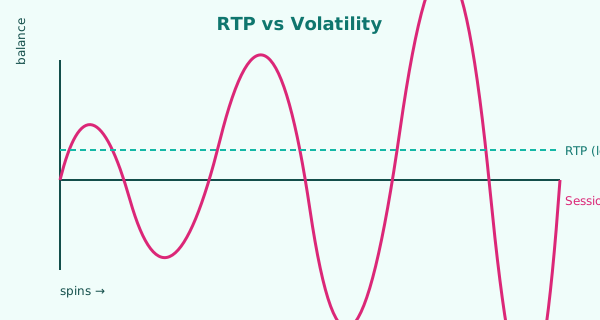
Volatility categories in slot design
Volatility, sometimes called variance, is the shape of the payout distribution rather than its average. A high-volatility pokie pays out large sums infrequently. A low-volatility pokie pays out small sums often. Two titles with the same 96% RTP can feel utterly different across a 500-spin session because their underlying volatility profiles are miles apart. Reviewers who talk only about RTP and skip volatility are only giving you half the picture.
The industry-standard descriptors are low, medium, medium-high and high, though a handful of studios publish numeric volatility indexes on a 1-to-10 scale. Betsoft, Nolimit City, Push Gaming and Hacksaw Gaming lean into high-volatility builds. Pragmatic Play and NetEnt cover the full spectrum. Play'n GO leans towards medium and medium-high volatility across most releases. Boutique studios often push into extreme volatility, where dead spins dominate but occasional hits reach five-figure multipliers of stake.
For payid pokies portfolios, the volatility mix at an operator is worth a quick scan before committing to a session bankroll. A catalogue skewed towards high-volatility Megaways-style games will drain a fixed bankroll faster than a portfolio full of medium-volatility classics with frequent small wins. Neither is "better"; they simply demand different session-length expectations. Match volatility to the time you want to spend and to the size of the bankroll you are willing to cycle.
Studio ecosystems in the review lens
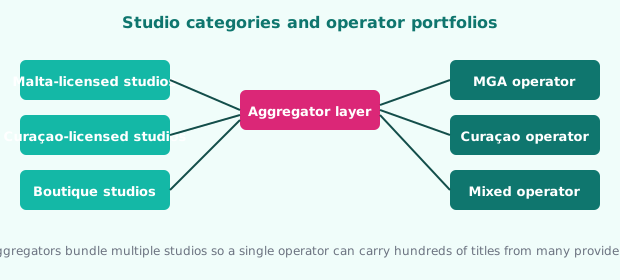
A modern payid pokies catalogue is not one operator's own creation. It is a stitched-together mosaic of studios, aggregators and boutique developers. Broadly the categories break down into the mainstream Malta-licensed studios, the Curaçao and lower-jurisdiction studios, and the boutique high-volatility studios that emerged in the late 2010s. Each category has its own visual language, feature grammar and RTP posture.
- Mainstream Malta-licensed studios build for regulated markets first. Their titles are subject to MGA audit trails and generally carry conservative RTP configurations.
- Curaçao-based and lower-jurisdiction studios take a wider approach — from prestige releases to fast-produced titles aimed at aggressive bonus mechanics.
- Boutique high-volatility studios push mathematical extremes, occasionally publishing hit rates as low as 1 in 400 base-game spins for a headline feature.
- Aggregator platforms bundle multiple studios into a single technical integration, so one operator can carry hundreds of titles across dozens of providers.
From the review chair, the studio ecosystem visible at any given payid pokies operator tells you more about the operating philosophy than the marketing copy does. Portfolios dominated by mainstream Malta studios tend to sit at more conservative operators; portfolios pushing many boutique titles indicate a leaner regulatory posture. Neither is a compliment or an accusation — it is diagnostic. Match the portfolio to the play style you want. If you want the best PayID pokies by category, the studio profile of an operator is your first read.
Megaways-style mechanics under the hood
Megaways is a licensed engine invented by Big Time Gaming that varies the symbol count per reel from spin to spin, producing up to 117,649 possible ways to win. Studios pay a licence fee to use the mechanic under the Megaways name. Megaways-style, by contrast, is a broader label covering any pokie with variable symbol counts and cascading wins — including many titles that use the pattern under different in-house branding. The player-visible feel is similar.
The engineering trade-off is that Megaways-style pokies almost always push into higher volatility. The variable symbol counts create wider payout distributions because occasional alignments can chain three or four cascades of wins before the reels stop moving. The base-game hit rate tends to be low; when a hit lands, it can be substantial. Bonus rounds compound this — unlimited win multipliers are common. From the SH Info bench, Megaways-style titles are best treated as sprint sessions with tight bankroll controls rather than marathon evenings.
Within payid pokies catalogues, Megaways-style builds show up heavily because they are a proven engagement mechanic. If the volatility profile suits you, they can be worth a look. If you prefer more predictable pace, the older three-reel classics still exist in the same portfolios and offer a different rhythm at the same stake.
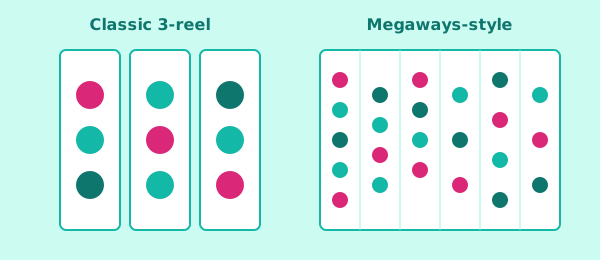
Classic three-reel layouts and their audience
Before video slots and Megaways-style mechanics dominated the shelves, pokies looked like their cabinet ancestors — three physical or virtual reels, a single payline, a lever handle. Modern three-reel pokies keep that visual grammar while running the same certified RNG as any other title. Studios that publish them regularly include NetEnt, Play'n GO and Novomatic-associated developers, plus a handful of retro-focused boutiques. Session pace is deliberately slower; the animation is lighter; the maths engine is the same.
For a payid pokies portfolio, classic three-reel titles are the counterweight to the high-volatility Megaways-style shelf. They usually sit in the low-to-medium volatility band. Their RTP tends to be transparent because the payline structure is simple enough to interpret without needing a paytable engineer. Some three-reel titles carry small in-game jackpots — a fixed sum that pays on the top symbol combination. The maths of those jackpots is priced into the RTP, not layered on top.
The audience for three-reel classics tends to be players who prefer session pace over feature complexity, or who want a lower cognitive load on an evening at home. A reviewer's honest read is that these titles get less press than the flagship Megaways-style releases but hold up well over long play. If your session priority is time-on-device with a stable bankroll, three-reel classics deserve a place in your rotation of payid pokies.
Live-dealer pokie-adjacent products
The word "pokies" strictly means reel-based games driven by an RNG. Live-dealer content is a different animal — real dealers in a studio, streamed video, players wagering on outcomes of physical wheels, cards or dice. However, a small number of live-dealer products blur into pokie-adjacent territory. Evolution's live-game-show format includes titles with reel-like presentations, spinning number wheels and animated bonus rounds that look reel-driven even though a human presenter is running the show.
These titles are increasingly bundled into payid pokies catalogues because operators want a single content shelf that covers both audiences. From a review perspective, treat them as their own category. The maths is different — a physical wheel with certified pockets rather than a virtual reel with a paytable — and the volatility profile is very different, often sitting at the higher end because of large multipliers on the bonus rounds. Do not read pokie RTP figures across to live-adjacent products; the numbers are not comparable.
Where live-adjacent products appear on a payid pokies portfolio, they signal an operator investing in the fuller Evolution catalogue rather than a slot-only shelf. Whether that is useful depends entirely on what you want out of the session. If you want reels and reels only, the live-adjacent titles are a distraction. If you like the format, they are a legitimate part of the modern portfolio.
Provider portfolios at MGA-licensed operators
An MGA-licensed operator holds a licence issued by the Malta Gaming Authority. The MGA regime is one of the older European regulators for online casino products and imposes technical, financial and player-protection controls on licensees. Studios integrated into MGA operators are usually themselves certified under a Class 4 supplier licence with an approved testing house certifying the RNG and paytable of every title. The audit trail is generally strong. From a reviewer's angle, MGA portfolios tend to look conservative and heavily anchored in the mainstream studios — NetEnt, Play'n GO, Pragmatic Play's MGA-certified builds, Red Tiger, Big Time Gaming and similar.
The RTP posture at MGA payid pokies portfolios is often the higher of any RTP options the studio offers. That is not a hard rule, but it is a pattern. The volatility mix skews slightly towards medium and medium-high rather than the extreme high-volatility boutique titles. If your review priority is documented audit trail and predictable behaviour, MGA-anchored payid pokies catalogues are the safer read. What they trade off is the newest boutique releases, which frequently launch on Curaçao operators first and reach MGA shelves later.
MGA does not mean an operator serves Australian players. Most MGA operators cover European markets first. Those that also accept Australian sign-ups and payid pokies deposits do so through separate business arrangements. The MGA badge in this context is a certification of studio integration standards, not a market-suitability statement.
Provider portfolios at Curaçao-licensed operators
Curaçao-licensed operators hold gaming licences issued under the reformed Curaçao Gaming Control Board framework. The regime is lighter than the MGA regime in some respects and permits a wider slate of studios to integrate, including the newer boutique high-volatility developers and the aggregator-only providers. Portfolios at Curaçao payid pokies operators are typically bigger by raw title count and broader in mechanical variety.
The trade-off is that studio audit trails are less standardised. Some Curaçao operators host studios that also hold MGA supplier licences — those titles are identical to their MGA-shelf equivalents. Others host studios operating only under Curaçao or Anjouan certification, where the testing regime is less publicly documented. A reviewer's rule of thumb is: if you cannot find the studio's certification page in a two-minute search, treat the RTP claim on the in-game info screen with more scepticism than you would at an MGA operator.
Curaçao payid pokies portfolios also carry a lot of the extreme high-volatility boutique titles that never reach MGA shelves at all. Nolimit City, Hacksaw Gaming and their peers cluster here. If aggressive volatility is what you want out of the session, this is the ecosystem that delivers it. If session-experience predictability is your priority, the MGA shelves are the safer address.
Mobile play experience end to end
Modern payid pokies are HTML5 builds. On a current Australian 4G or 5G connection, load times sit in the two-to-five-second range for most titles. Spin latency, the delay between tapping the spin button and the reels starting to move, is typically under 100 milliseconds. Frame rates are stable across most mid-range Android and iOS devices manufactured in the last four years. The mobile build of a pokie is not a stripped-down version of the desktop game — it is the same game with a responsive interface.
What changes on mobile is the interface geography. The spin button is usually a large right-hand thumb target. The paytable and info panel collapse into a menu. Autoplay controls, when present, move to a secondary screen. On the smaller display, symbols on Megaways-style grids become tiny; the game becomes more about the sound design and the flow than about reading each symbol on each spin. Reviewers who habitually test on both platforms find that classic three-reel pokies scale to mobile better than dense Megaways-style grids simply because the symbols stay legible.
Session battery drain is worth noting. HTML5 pokies with heavy animation loops can pull 8-12% battery per hour on a modern smartphone. Screen brightness dominates the number, but the animation loops themselves are a measurable factor. If session length matters to your rotation of payid pokies, favouring lighter three-reel titles or reduced-animation Megaways-style builds is a practical adjustment.
Session length and pace
How long a payid pokies session runs and how many spins it fits in are both design decisions worth thinking about before you start. A base-game spin cycle in most modern titles takes 3-5 seconds if autoplay is engaged, longer if manual spin animations are watched to completion. A 30-minute session at that pace produces 300-600 spins. A high-volatility Megaways-style title with an average base-game hit rate of 1 in 4 spins will still show long dry patches within that window; a low-volatility three-reel classic will hit smaller wins far more often.
| Session type | Approx spins | Bankroll behaviour | Best-suited volatility |
|---|---|---|---|
| Short session (10-15 minutes) | 100-200 | High swing potential in either direction | Medium; extreme volatility likely to disappoint |
| Standard evening (30-45 minutes) | 300-600 | Pull towards theoretical RTP begins | Medium and medium-high |
| Long session (60-90 minutes) | 700-1500 | Session RTP closer to certified figure | Any; high-volatility can pay out here |
| Marathon (2+ hours) | 1500+ | Total money cycled becomes large | Low or medium for capital preservation |
The pull towards theoretical RTP is real but slow. Statistical convergence in payid pokies play needs many thousands of spins to be meaningful. Session outcomes therefore remain governed by variance rather than average. Treat pace as an input to your bankroll planning: faster pace means more money cycled per hour, not more money won. See the payid pokies real money guide for a longer treatment of bankroll behaviour by pace.
Autoplay and safer-play features
Autoplay is a feature present in most modern payid pokies that lets a player queue a fixed number of spins to run without needing to tap between each one. Studios operating under stricter European regulation have added mandatory autoplay guardrails — required stop conditions on single wins above a threshold, on balance drops below a floor, on remaining balance running out, and on bonus feature triggers. Studios operating under lighter regimes may not include those guardrails by default; some offer them optionally, others not at all.
- Set a spin count that fits your session, not the maximum available.
- Enable the "stop on any win over X" toggle where present.
- Enable "stop on balance decrease of X" where present.
- Always keep the "stop on bonus feature" toggle enabled so features are played consciously.
- Do not stack autoplay across multiple titles simultaneously in different browser tabs.
Safer-play tooling has broadened over the past three years. Deposit limits at the operator cashier, session-length pop-ups, cool-off periods and reality-check prompts are now the norm at most reputable payid pokies operators, though not universally present. Reviewers check for the toggles because their presence signals an operator's compliance posture. If a payid pokies operator does not offer even basic deposit limits, that is a red flag worth noting. The payid pokies free play guide covers how demo mode can supplement safer-play habits by letting you rehearse a title before committing real funds.
Frequently Asked Questions
What are payid pokies in plain terms?
The phrase refers to online slot games played at offshore-licensed operators that accept PayID as a deposit method. Australia does not license domestic online casinos, so the pokie titles themselves sit on operators licensed in Malta, Curaçao and similar jurisdictions. PayID is the payment identifier; the pokies are the games.
Do RTP percentages guarantee a session outcome?
No. RTP is a mathematical long-run average calculated over millions of simulated spins. Any single session can vary sharply above or below the number. Treat it as a design specification, not a session forecast. Two players on the same title on the same day can walk away with wildly different results even with a fair RNG.
How do studios differ between MGA and Curaçao operators?
MGA-licensed operators typically host studios with matching MGA certification, giving stricter audit trails and generally the higher RTP configuration. Curaçao operators run wider portfolios that include both MGA-certified titles and studios operating under other licences, including newer boutique high-volatility studios. The player-visible game engine is often identical either way; the audit posture around it differs.
Are Megaways-style pokies always high volatility?
Most Megaways-style mechanics land in the medium-high to high volatility range because their variable symbol counts and cascading wins create wide payout distributions. A minority of titles are tuned to medium volatility. Always check the info screen inside the game — studios publish volatility ratings there rather than in marketing copy.
What does the mobile pokies experience actually feel like?
On a modern Australian mobile connection, HTML5 pokies load in a few seconds, respond within one frame to a spin tap and hold the same maths engine as the desktop build. Screen size is the main visual trade-off — dense Megaways-style grids get harder to read on smaller devices while classic three-reel titles scale down cleanly.
Is checking demo mode a reliable way to evaluate a pokie?
Demo mode uses the same reel maths and animation as real money, so it is useful for testing pace, feature triggers and interface. It cannot forecast personal results because demo variance still runs over too few spins to reflect the theoretical RTP. Use demo to evaluate design and mood; use bankroll planning to prepare for real-money variance.
Do offshore operators publish RTP values honestly?
Reputable studios publish RTP inside each game info panel and in their public documentation. Some operators are permitted to select from multiple RTP configurations. Trust the in-game number over marketing copy on landing pages, and be sceptical when a landing page trumpets a headline RTP that does not match the info screen inside the actual game.
Does session length change the outcome distribution?
Yes. Longer sessions on a fixed stake pull results closer to theoretical RTP, but also increase total money cycled through the machine. Shorter sessions carry wider outcome variance in either direction. Neither is inherently better; both need honest bankroll planning matched to the volatility of the payid pokies title being played.

Olivia Parker
Pokies Reviewer · SH Info
Olivia reviews Australian pokies since 2017 with a focus on RTP claims, volatility experience and provider ecosystems. She distinguishes documented behaviour from marketing narrative.
Responsible Play
Pokies of any kind — payid pokies included — are entertainment products with a house edge built into the maths engine. Over long enough play, the expected value moves against the player. Treat any money placed as a session cost rather than an investment. Set a session budget before opening the cashier, decide the walk-away point before spinning, and never chase a losing session with an increased stake. The problem gambling literature is worth reading if you find your sessions creeping past your original limits.
Australian residents concerned about their own play or a family member's play can contact Gambling Help Online or Lifeline; both offer confidential 24/7 support. The national self-exclusion register BetStop binds domestic-licensed operators; offshore payid pokies operators do not check it, so self-imposed limits at the operator cashier and at your bank account carry more weight in that context. Read the Australian gambling framework under the Interactive Gambling Act 2001 for the legal context.