
What "best" means for a pokies review
The word "best" is a slippery one in the pokies world. Every operator's landing page will tell you they have the best games. Every studio's press release will describe their newest release as their best yet. As a reviewer of payid pokies from an experience angle, this SH Info guide treats "best" as a claim that must be defended with criteria and evidence. If a title is called best on this page, the reason will be stated and the category will be named.
Best is category-specific because pokies are not a single product. A three-reel classic with a 96.6% RTP and low volatility is genuinely the best title for a stability-seeking session with a modest bankroll. A Megaways-style build with a headline 96.2% RTP and high volatility is genuinely the best title for a short high-stakes swing session where the goal is a shot at a large payout. Neither is universally better than the other. Framing best as a fit-for-purpose judgement means the review can serve players with different session profiles honestly.
Best also has to include what the player can actually reach. A stellar pokie unavailable to Australian audiences on any operator that accepts PayID is irrelevant here. The best payid pokies list is filtered by both design merit and practical availability. That constraint changes the picture — some highly regarded studios simply do not show up on the Australian-facing payid pokies operators because their MGA licence terms restrict market coverage.
Evaluation criteria set out openly
To evaluate the best payid pokies in any category, this SH Info bench uses six explicit criteria. The list is short deliberately — extra criteria dilute the judgement rather than sharpen it.
- Certified RTP — the number shown in the game info panel, not the marketing headline.
- Volatility category — the studio's own volatility rating, cross-checked against session behaviour.
- Feature triggers — how often the bonus feature lands, what it pays and whether it is buyable.
- Interface clarity — how legible the paytable is and how quickly a new player understands the rules.
- Provider audit trail — whether the studio publishes certifications transparently.
- Availability at payid pokies operators — whether Australians can actually reach the title.
Each criterion is scored on a plain descriptive scale — strong, adequate, weak — rather than a numeric composite that risks giving false precision. A title that scores strong on all six is best-in-category. A title strong on four and adequate on two is a solid recommendation. Titles weak on any criterion are called out honestly and not buried.
The order of criteria matters. Certified RTP and volatility category come first because they define the maths of the session. Feature triggers and interface clarity come next because they define the play experience. Provider audit trail and operator availability come last because they define whether the review is practically useful for an Australian audience playing payid pokies. This ordering is a deliberate reviewer's choice; other reviewers might weight differently and would say so up front.
High-RTP category — the stability shelf
The high-RTP category covers pokies with certified return figures at 96.5% or above. On payid pokies portfolios the shelf is dominated by NetEnt classics, Play'n GO staples, Blueprint Gaming's mid-volatility releases and Big Time Gaming builds without cascading multipliers. Typical volatility in this category is low-to-medium. Feature triggers are frequent but modest in payout — free-spin rounds that add a few multipliers rather than uncapped runaway multipliers.
The design ethos of high-RTP category pokies is stability over spectacle. Sessions play at a steady pace. The bankroll drifts down slowly rather than in dramatic swings. The bonus feature lands often enough that a 30-minute session almost always gets to experience it at least once. From the review chair, these are the titles to recommend when a player is new to online pokies, when the bankroll is small relative to a preferred stake, or when the goal is time-on-device rather than a hunt for a big win.
Within the high-RTP category, the best-in-slot title depends on interface preference. Players who like a busy grid with lots of animation will lean towards Play'n GO's brighter releases. Players who prefer a cleaner presentation will lean towards NetEnt's older titles. The certified RTP figures are similar across the shelf; the differentiator is the play feel. On any modern payid pokies portfolio, at least five or six titles in this category will be present.
High-volatility category — the swing shelf
The high-volatility shelf is where the boutique studios live. Nolimit City, Hacksaw Gaming, Push Gaming and the newer Curaçao-licensed studios build titles with base-game hit rates below 1 in 4 spins and bonus features that occasionally deliver five-figure multipliers of stake. RTP figures in this category cluster around 96% but sometimes drop to 94% in exchange for higher maximum-win potential. The volatility rating is 4 or 5 out of 5 on the studio's own scale.
Session behaviour on high-volatility payid pokies is punishing. Long dry patches — 50, 100, sometimes 200 spins without a meaningful hit — are expected. The maths engine is not broken; it is behaving as designed. When a hit lands, it can be large. The base game is a waiting room for the bonus feature; the bonus feature is where the maths of the title actually lives. Some titles in this category expose a "bonus buy" mechanic that lets players skip directly to the feature at a stake multiplier of 50x to 500x. In jurisdictions where bonus buy is banned, the studios ship the same title without the option.
| Category | RTP band | Volatility | Session fit |
|---|---|---|---|
| High-RTP classics | 96.5% - 97.5% | Low to medium | Long stable sessions, small bankroll |
| Megaways-style | 96.0% - 96.6% | Medium-high to high | Medium sessions, willing to ride variance |
| Boutique high-vol | 94.0% - 96.5% | High to extreme | Short sessions, big-swing tolerance |
| Low-vol jackpot | 94.0% - 96.0% | Low | Long sessions, small stakes, jackpot hope |
Reviewing the best payid pokies in the high-volatility shelf demands session discipline. The titles are entertaining and technically impressive, but they are not built for a stable evening on a small bankroll. If you want to try them, size the stake down until 200 dry spins does not blow the budget. That way the session lasts long enough to reach the bonus feature the maths engine is actually pricing in.
Low-volatility jackpot category
Between the stability shelf and the swing shelf sits a smaller category — low-volatility pokies with a fixed or progressive jackpot layered on the top symbol combination. Titles in this category tend to have RTP figures in the 94-96% band because the jackpot cost is priced into the base game maths. Volatility is low; the base game hits often. The jackpot itself is an infrequent event, but even when it never triggers in a session, the base game feels lively and paced.
Examples of the low-volatility jackpot pattern on payid pokies portfolios include a set of Play'n GO retro titles, some of the older Microgaming-derived jackpot builds, and a handful of boutique releases that lean into a slower session tempo. From the review chair, this category is undersold in most operator marketing because "jackpot" is glamour-loaded and gets bundled with the progressive giants instead. That is a shame — the low-volatility jackpot format has real merit for players who want the base game to carry the session and treat the jackpot as a bonus rather than the point.
The best-in-category picks here favour transparency about jackpot mechanics. A studio that explains whether the jackpot is fixed, progressive or seeded, and what the trigger conditions are, scores higher than a studio that leaves the jackpot as vague marketing copy. On payid pokies portfolios the transparent studios are usually the older mainstream ones; boutique studios cluster higher on the volatility scale and rarely play in this category at all.
Provider ecosystem effect on category quality
Category quality varies by ecosystem. On MGA-licensed operators, the high-RTP category is deep and well-populated because the studio audit posture rewards conservative maths. On Curaçao-licensed operators the high-volatility category is deep because more boutique studios integrate there. The low-volatility jackpot category tends to be thin on both types of operator because the studios building in this category are relatively few.
What this means for a payid pokies best-of review is that the operator you choose limits which category leaders are actually reachable. If a Malta-only studio's best title is not integrated with the Curaçao operator you have deposited PayID funds at, that title is off the table. If a boutique high-volatility studio only integrates via Curaçao aggregators, an MGA-only operator cannot serve it. Availability is a hard filter, not a soft preference. See the studio-ecosystem map for how studios flow to operators through the aggregator layer.
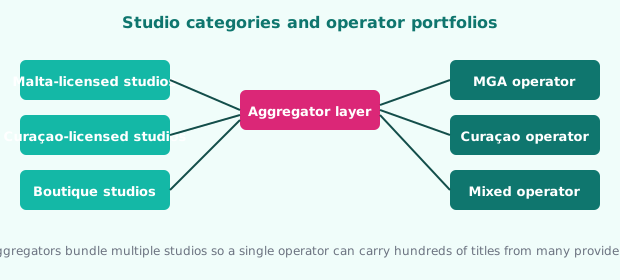
Availability at PayID-accepting operators
Availability at operators accepting PayID from Australian bank accounts is the practical constraint on any payid pokies best-of list. Some operators publish their full studio-partner list on a corporate page; others make it visible only inside the game lobby. A reviewer checking availability visits the actual lobby, searches for the title by name and confirms it loads under an Australian IP address rather than relying on marketing pages.
- Open the operator's game lobby without logging in first.
- Search for the specific title name; check that the tile actually loads.
- Confirm the game info panel shows the certified RTP figure and volatility rating.
- Verify the title is not region-restricted by launching demo mode; if demo works, real money at that operator will too.
- Cross-check the studio's own release list against what appears at the operator to spot silently missing titles.
Availability is not stable over time. Studios pull titles from operators for regulatory reasons; operators pull studios for commercial reasons. A payid pokies portfolio audited today may look different in three months. That is why a category-first review approach is more useful than a title-by-title one — categories persist even when specific titles come and go. Cross-reference availability against the payid pokies real money guide before committing bankroll to a specific title.
What "best" isn't
The best payid pokies list is not a set of titles the reviewer personally enjoyed most. Personal enjoyment is a feature of category-fit judgement, not the primary criterion. Best is not the newest release; new titles are inherently untested at scale and their behaviour at the tails of the distribution has not yet been observed by enough players over enough spins. Best is not the loudest marketing campaign, the biggest jackpot in the pool, or the title in the widest carousel on the operator's landing page.
Best is also not the title with the biggest maximum-win figure. Maximum-win figures are theoretical caps — the largest single payout the maths engine permits. Reaching one is astronomically unlikely. A title advertised as "25,000x max win" and a title advertised as "50,000x max win" will feel identical over any realistic sample of spins because both max wins sit in the tail beyond what a session ever reaches. The RTP figure and the volatility rating are far better session-level predictors than the max-win headline.
And best is not permanent. A title that leads a category today may drop as the studio issues an updated build, an operator swaps to a lower-RTP configuration, or a new competitor releases a stronger design. Any review site that pins category leaders in place forever is not doing its job. This SH Info page will be reviewed and updated as portfolios shift.
Reading marketing claims critically
Operator marketing copy about payid pokies uses several patterns worth learning to spot. The word "hot" or "trending" often just means "featured this month". The phrase "highest RTP" without a specific number attached is meaningless because RTP figures are close across categories. The claim "over 3,000 pokies" is theatrical — most sessions will play only a handful of titles from a portfolio, so total headcount does not affect quality of session.
Studio marketing copy has its own patterns. A "megawin potential" claim is a max-win figure and, as covered above, has little session relevance. A "brand new mechanic" claim is usually a variant of an existing pattern with fresh branding. A "player-favourite" claim rests on data the studio does not publish, so verification is impossible. Read these claims the way you would read any advertising copy — designed to persuade, not to inform.
What is worth trusting is the in-game info panel. That panel is subject to certification and audit; false statements there are a compliance failure. Certified RTP, volatility rating, hit frequency and maximum-win figures are all specified there. When the marketing copy on the operator landing page and the in-game info panel disagree, the info panel wins every time. Reviewers use the info panel; players benefit from doing the same. Return to the payid pokies homepage for the fuller overview of RTP mechanics.
Frequently Asked Questions
What does "best" actually mean in a payid pokies review?
It means best fit for a category and a session style, not best in an absolute sense. A high-RTP classic is best for stability-seeking sessions; a high-volatility Megaways-style build is best for high-stakes swing-play sessions. Best is only meaningful against a stated criterion.
Should I chase the highest RTP number I can find?
The 96%-plus RTP band is worth targeting, but do not chase headline figures without checking volatility and hit rate. A 97% RTP high-volatility title can wipe a small bankroll faster than a 95% low-volatility one over a short session because the shape of the payout distribution matters as much as its average.
Do Megaways-style titles pay out better?
Not better on average. They pay out less often but occasionally in larger bursts. The RTP over the theoretical long run may be similar to a classic three-reel title; the shape of getting there is completely different. Session tolerance for dry spells matters more than raw RTP.
How does provider choice change what "best" looks like?
A studio with strong audit certification and a documented RTP-configuration policy earns a higher review score under the criteria that matter here. Marketing brand recognition is a much weaker signal than certification transparency in a payid pokies review context.
Is a low-volatility jackpot title actually a good idea?
For players who value time-on-device with a small bankroll and mild engagement, low-volatility jackpot titles are a legitimate category. The jackpot cost is priced into the base-game RTP so the maths still works out; the trade-off is that the base-game hit rate is what fills most sessions.
Is availability at a PayID-accepting operator part of the review?
Yes. A payid pokies review that lists titles unavailable to Australian players is a hollow review. Availability at operators that accept PayID from Australian banks is a hard constraint on category evaluation and no honest best-of list can skip it.
What is "best" not?
Best is not the flashiest new release, the loudest marketing campaign or the widest bonus offer at an operator. Best is the fit between a documented title design and a stated session profile. That framing keeps the review honest and practically useful.

Olivia Parker
Pokies Reviewer · SH Info
Olivia reviews Australian pokies since 2017 with a focus on RTP claims, volatility experience and provider ecosystems. She distinguishes documented behaviour from marketing narrative.
Responsible Play
A best-of list is a starting point for informed play, not a shopping list. The best payid pokies for you depend on your bankroll, your session-length preference and your tolerance for variance. Set a session budget before opening the cashier. Do not chase losses across categories by moving from a low-volatility title to a high-volatility one hoping for a swing. Read the Return to Player literature to understand what the certified RTP figure does and does not tell you.
Australia's regulatory framework for interactive gambling sits under the Interactive Gambling Act 2001. That framework targets operators, not players. Gambling Help Online and Lifeline provide confidential 24/7 support to Australian residents who want to talk through play habits, and the BetStop national self-exclusion register binds domestic-licensed operators. Offshore payid pokies operators are outside that register, so cashier-level and bank-level limits carry more weight in the offshore context.